How to Choose a Book at the Right Level in a New Language
Almost everyone who tries to learn a language by reading fails the same way. They buy a book they genuinely want to read, open it full of good intentions, hit nine unknown words in the first paragraph, and quietly put it down. Two weeks later it is still on the shelf, and the story they tell themselves is "I am not ready to read yet."
Usually that is not true. What happened is a book-choosing problem, not a language problem. So this post is about the least glamorous and most important skill in reading-based learning: judging, before you commit forty hours, whether a book is at your level.
The sweet spot is "slightly too hard"
There are two ways to get this wrong.
Choose a book that is too easy and reading feels great, but very little sticks. You already know every word, so nothing new arrives. It is pleasant practice for fluency and reading speed, and there is a place for that, but your vocabulary barely moves.
Choose a book that is too hard and you spend more time in the dictionary than in the story. The plot never builds momentum, so the thing that was supposed to pull you through the book stops pulling. Every language learner has abandoned a book this way.
The sweet spot sits just above your current level. You understand the sentence, you follow the scene, and every so often a word arrives that you do not know but can mostly guess from context. That is the shape of reading that grows vocabulary, because you get the meaning from the story and the word gets attached to something memorable rather than to a dictionary entry.
If you want the numbers behind this, we wrote them up in how many words you need to read fluently. The short version is that comfortable reading tends to start around the point where you know roughly 98 out of every 100 words on the page, and reading becomes hard work below about 95.
The two-minute page test
You do not need a formula. You need one page and two minutes, and you can do this standing in a bookshop or in the sample chapter of an ebook.
- Open the book somewhere in the middle, not the first page. Openings are often written more carefully and more densely than the rest of the book, so they make everything look harder than it is.
- Read one full page at your normal pace. Do not look anything up.
- Count the words you did not know.
Now read the result:
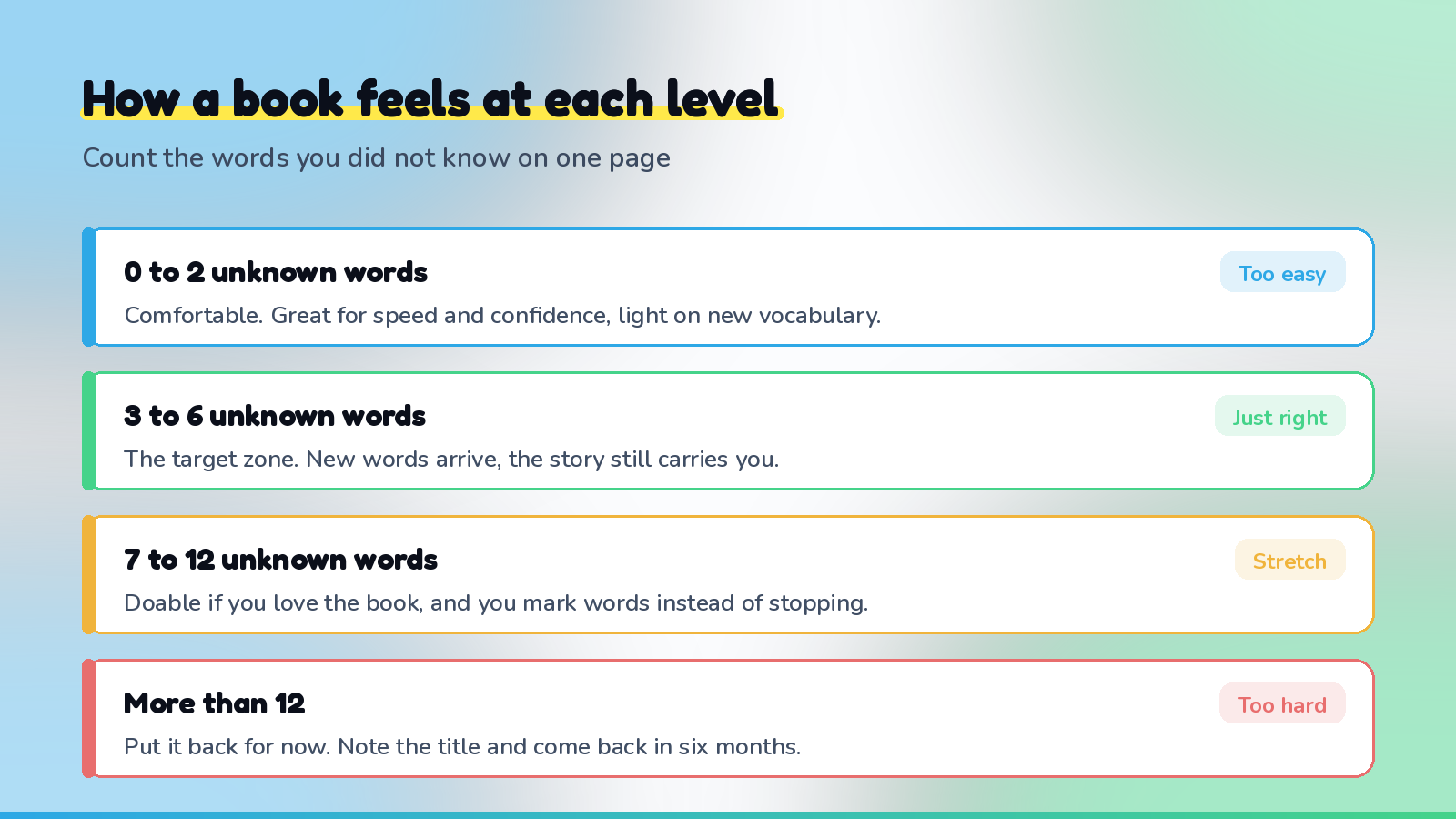
- Zero to two unknown words per page. Comfortable. You will fly through it and enjoy it, and you will pick up a modest amount of new vocabulary. Good for building reading stamina and confidence.
- Three to six unknown words per page. This is the target zone. Hard enough to teach you something, easy enough that the story still carries you. If you find a book here, buy it.
- Seven to twelve unknown words per page. Doable, but only if you really want this particular book, and only with a plan for handling the new words. More on that below.
- More than twelve. Put it back for now. Not forever. Write the title down, come back in six months, and enjoy the moment when it turns out to be easy.
One important adjustment: ask yourself whether you understood the scene, not just the words. Some readers know almost every word and still cannot say what happened, usually because of long sentences or unfamiliar structure. Some readers miss ten words and follow the scene perfectly. Following the scene is what matters.
Graded readers versus real novels
Graded readers are books written or rewritten with a controlled vocabulary, usually labelled by level. They have an unfair reputation as being for children or for beginners with no taste. Modern ones are better than that, and they do something no native novel can do: they guarantee the difficulty.
Use them when you are early on and cannot yet find native material in the three-to-six-unknown-words zone. They let you do a lot of reading at the right level, quickly, which is what builds the base. Read several at one level, then move up. The goal is volume, not prestige.
Move to native material when the page test starts coming out favourably, or when you notice you are bored. Boredom is real information. If you are not curious about what happens next, the book has stopped doing its main job.
A few kinds of native books that tend to punch below their weight in difficulty:
- Books you have already read in your own language. You know the plot, so the story carries you through the gaps. Massively underrated.
- Contemporary young adult fiction. Modern vocabulary, shorter sentences, strong plot pull.
- Genre fiction with repeated settings, like detective series. The same vocabulary keeps coming back, which is exactly what you want, and each book gets easier than the last.
- Translations into your target language. Translated prose is often a little plainer than original literary writing in the same language.
The ones that tend to be harder than they look: literary fiction with heavy style, anything historical, poetry, and classics. Classics in particular are full of vocabulary that no living person uses, which is a poor return on the effort.
What to do when the book is a little too hard
Sometimes the answer to "is this at my level" is "not quite, but I want it anyway." That is allowed. A book you are genuinely excited about will pull you further than a perfectly levelled book you feel neutral about. You just need to handle the extra unknown words so they do not stop you.
Two rules make this work.
Rule one: do not look up everything. Look up a word only when you cannot follow the sentence without it, or when you have now seen it three or four times and it clearly matters to this book. Everything else, let it go past. This feels wrong the first few days and then feels obvious.
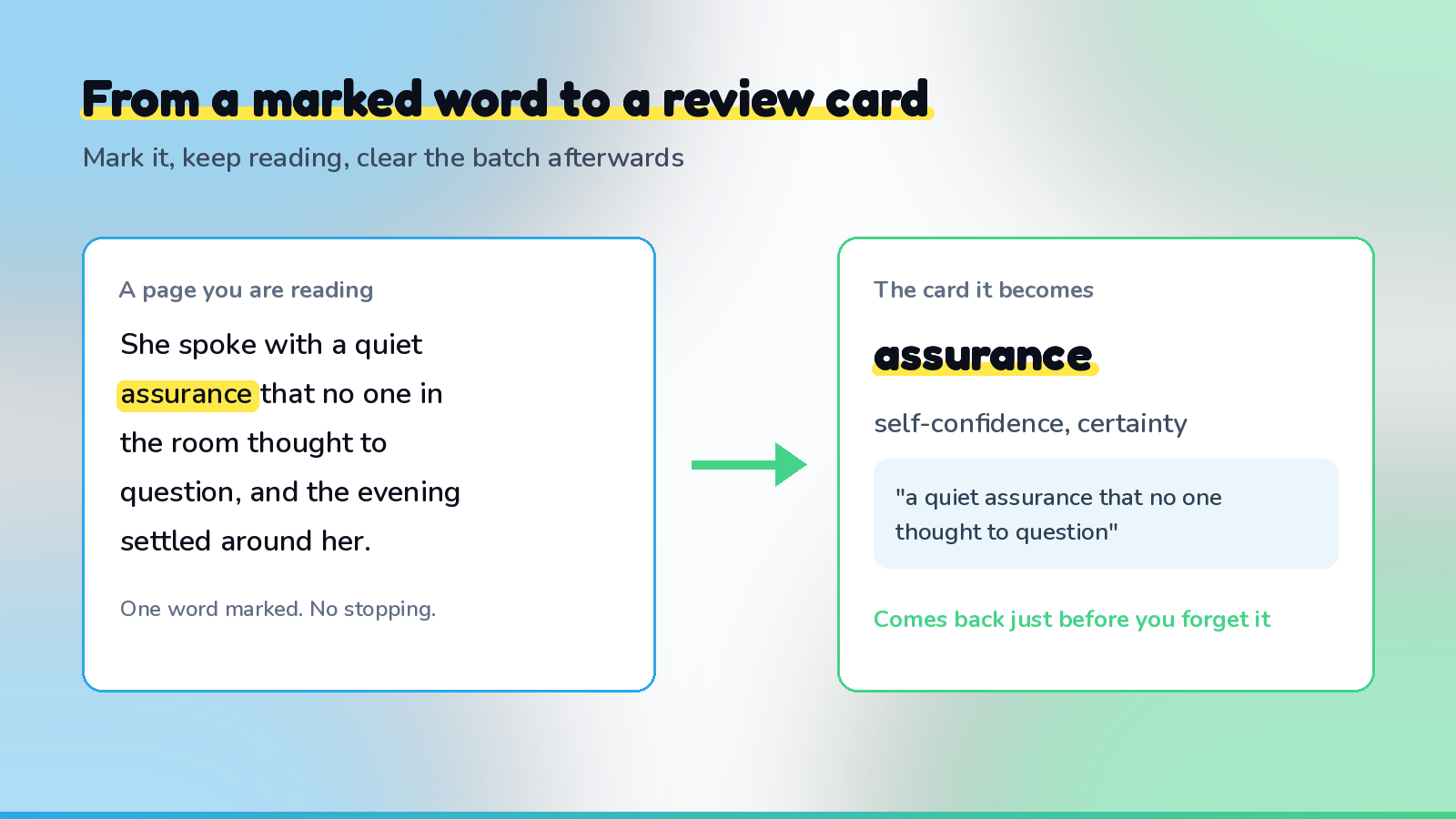
Rule two: mark, do not stop. When a word is worth keeping, put a light pencil line or a small highlight under it and keep reading. The whole point is to protect the flow of the story, which is the thing making you turn pages. We went deep on this in how to remember words from novels.
Then, at the end of the chapter or the end of the session, deal with the marked words in one batch. With Vocaboodie you snap a photo of the page, the words you marked are pulled out with the sentence they came from and translated, and they drop into a review schedule that brings each one back just before you would have forgotten it. The book stays a book, and the vocabulary work happens in a couple of minutes afterwards rather than every eight seconds during. If you would rather do it by hand or in another tool, that works too, and making cards from a book covers the manual route honestly.
The practical effect is that a book at seven to twelve unknown words a page becomes readable, because the words you meet are not gone the next day. Each chapter you finish makes the next chapter easier, and the book gets lighter as you go.
Give a book three chapters, then decide
One last habit worth building. Do not judge a book on the first ten pages. Openings introduce names, places and setup all at once, and they are almost always the densest part of a novel. Give any book three chapters. By then you have met the recurring vocabulary, your brain has settled into the author's rhythm, and the honest verdict shows up.
If it is still a fight after three chapters, stop. Abandoning a book is not failure, it is calibration. Put it back on the shelf, take the next one down, and remember that the book that felt impossible last spring is very often the one you finish in a weekend next year.
The short version
- Aim for three to six unknown words per page. That is where reading grows vocabulary without killing momentum.
- Use the two-minute page test on a page from the middle of the book, not the first page.
- Graded readers guarantee the level and are worth using early. Move to native books when the page test says you can, or when you get bored.
- Re-reads, young adult fiction, series, and translations are usually easier than they look. Classics and literary fiction are usually harder.
- If the book you love is slightly too hard, mark words instead of looking them all up, and clear the marked ones in one batch afterwards.
Choosing well is most of the work. Get the level right and reading stops being a study task you have to force yourself through, and goes back to being the thing you would have done anyway.